R40bn opportunity for hemp industrialisation in South Africa requires policy support – LSF study

Localisation Support Fund CEO Irshaad Kathrada welcomes the launch of the organisation’s Hemp Industrialisation Study Report; while Hemp and Cannabis Master Plan project manager John Jeffrey provides commentary on the regulatory framework surrounding hemp. Video and editing: Tasneem Bulbulia



South Africa has the potential to capitalise on a domestic industrial hemp market opportunity valued at R40-billion by 2040; however, this requires proper industry development and policy support, a new industrialisation study published by the Localisation Support Fund (LSF) in partnership with the Presidency, the Industrial Development Corporation and the Department of Trade, Industry and Competition has found.
The study outlines a path for hemp industrialisation to become a meaningful driver of reindustrialisation, diversification, decarbonisation, export growth and inclusive rural economic development across the country.
Commissioned by the LSF and undertaken by strategy and advisory company Zageta Solutions together with the Development Policy Research Unit at the University of Cape Town, the study builds on previous work and aligns with the objectives of the National Cannabis Master Plan.
Globally, the hemp market is projected to grow from about $10-billion in 2025 to $37-billion by 2032.
Presenting key findings from the study at the launch in Johannesburg on March 4, the study authors said the domestic industry is projected to grow from R7.3-billion in 2025 to R17.7-billion by 2030, and R40.4-billion by 2040.
Diverse agro-ecological zones and a counter-seasonal production cycle would enable South Africa to supply global markets year-round, filling gaps left by Northern Hemisphere producers.
Importantly, the country’s established manufacturing clusters in automotive, textiles, pulp and paper and food processing provide ready-made demand pathways for hemp-derived inputs, lowering the barriers to commercial scale-up.
As a later entrant, South Africa can also bypass the costly trial-and-error phase that slowed early adopters, instead designing value chains that are competitive and standards-aligned from inception.
The country can also leverage its role as a continental trade gateway under the African Continental Free Trade Area.
Since 2022, South Africa has issued 1 725 permits, granting legal cultivation rights across 29 000 ha of land, primarily in Gauteng, KwaZulu-Natal and the Eastern Cape.
The study cautions that the absence of industrial-scale processing infrastructure, especially in primary processing, is the most critical bottleneck to sector growth.
Also, regulatory fragmentation, especially the need to clearly separate industrial hemp from intoxicating cannabis in legislation, continues to constrain investment and industry development.
The study identifies five priority industrial pathways where South Africa's hemp sector should concentrate its early development efforts.
The food and beverage sector has been identified as the most immediately accessible, with grain-based products such as hemp milk, flour and edible oils integrating readily into existing oilseed and food-processing platforms.
Personal care, which encompasses hempseed oil-derived creams, serums and wellness products, offers similarly low entry barriers and strong alignment with the country’s existing manufacturing base, lending itself to small, medium and micro enterprises.
Pulp and paper presents a strategic opportunity to absorb underused straw biomass through biodegradable packaging and cellulose-based materials, leveraging established technology already from the forestry sector.
The remaining two priority pathways point toward longer-term industrial scale.
General textiles are highlighted as ideal for non-woven and technical applications that can use fibre from dual-purpose grain crops without requiring the highest processing standards.
Building and construction, driven by global decarbonisation imperatives, focuses on materials like hempcrete and insulation, with hemp hurds accounting for roughly 65% of the stalk offering substantial volumetric supply potential.
The five pathways were selected because they share a common profile, mainly, strong and growing demand, proven or adaptable technology and realistic prospects for localisation within South Africa's existing industrial footprint.
Unit economic analysis shows that mechanised, scale-based farming operations demonstrate the strongest returns, while smaller, labour-intensive models struggle to achieve profitability owing to harvesting and processing constraints.
Farmer returns are highly sensitive to access to reliable off-take markets and nearby processing infrastructure, emphasising the need for coordinated value chain development instead of a supply-led approach.
The study calls for a deliberate minimum programme of action, further than just lifting of regulatory barriers.
This entails establishing a concessional early-stage financing instrument to make the entry costs of processing infrastructure manageable and to crowd in private capital; identifying and actively supporting first-mover companies that are building the tacit and technical knowledge the sector needs across the full value chain, from seed selection and agronomic practice through to decortication and product development; and designing aggregation and clustering models that allow farmers, processors and downstream manufacturers to develop in proximity and at viable scale.
Underpinning this is a need for dedicated project preparation capacity in both public and private institutions that is capable of translating the sector’s potential into bankable, investible propositions.
Article Enquiry
Email Article
Save Article
Feedback
To advertise email advertising@creamermedia.co.za or click here


Projects
Latest Multimedia

Latest News


Showroom
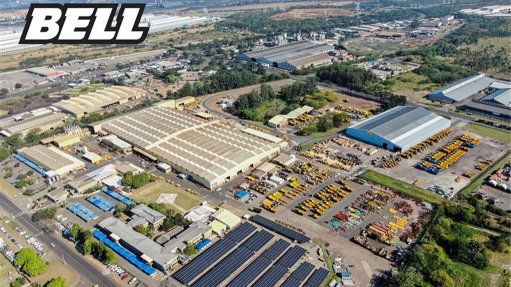
As one of South Africa's leading manufacturers, Bell Equipment distributes and exports its wide range of heavy equipment globally to mining,...
VISIT SHOWROOM
ISO-certified Condra manufactures overhead cranes, portal cranes, cantilever cranes and crane components: hoists, drives, end-carriages, brakes and...
VISIT SHOWROOM


Press Office
Announcements
What's On
Subscribe to improve your user experience...
Option 1 (equivalent of R125 a month):
Receive a weekly copy of Creamer Media's Engineering News & Mining Weekly magazine
(print copy for those in South Africa and e-magazine for those outside of South Africa)
Receive daily email newsletters
Access to full search results
Access archive of magazine back copies
Access to Projects in Progress
Access to ONE Research Report of your choice in PDF format
Option 2 (equivalent of R375 a month):
All benefits from Option 1
PLUS
Access to Creamer Media's Research Channel Africa for ALL Research Reports, in PDF format, on various industrial and mining sectors
including Electricity; Water; Energy Transition; Hydrogen; Roads, Rail and Ports; Coal; Gold; Platinum; Battery Metals; etc.
Already a subscriber?
Forgotten your password?
Receive weekly copy of Creamer Media's Engineering News & Mining Weekly magazine (print copy for those in South Africa and e-magazine for those outside of South Africa)
➕
Recieve daily email newsletters
➕
Access to full search results
➕
Access archive of magazine back copies
➕
Access to Projects in Progress
➕
Access to ONE Research Report of your choice in PDF format
RESEARCH CHANNEL AFRICA
R4500 (equivalent of R375 a month)
SUBSCRIBEAll benefits from Option 1
➕
Access to Creamer Media's Research Channel Africa for ALL Research Reports on various industrial and mining sectors, in PDF format, including on:
Electricity
➕
Water
➕
Energy Transition
➕
Hydrogen
➕
Roads, Rail and Ports
➕
Coal
➕
Gold
➕
Platinum
➕
Battery Metals
➕
etc.
Receive all benefits from Option 1 or Option 2 delivered to numerous people at your company
➕
Multiple User names and Passwords for simultaneous log-ins
➕
Intranet integration access to all in your organisation